
Get fitter/exercise a little (more)? Lose weight? Get out and about/socialise more? Challenge yourself to achieve something? Become a more ‘glass half-full’ person, and less a ‘glass half-empty’ person?
If any of those, or similar resonate, and you’re struggling to get going and get on with it, let’s acknowledge that waiting until we find the motivation is not going to help. Motivation often follows action. And it’s closely linked to emotions and feelings, which like motivation, can wax and wane.
We can also find ourselves making (lame!) excuses and justifications and procrastinations for not acting, and making a change.
So, here’s a strategy I’d like to recommend for you to adopt that’s going to help.
We’re going to follow the estimable Steve Peters’ model – he of ‘Chimp Management’ fame – to illustrate how we can do it.
It’s likely that the following 3 factors need to be in place for a change to occur:
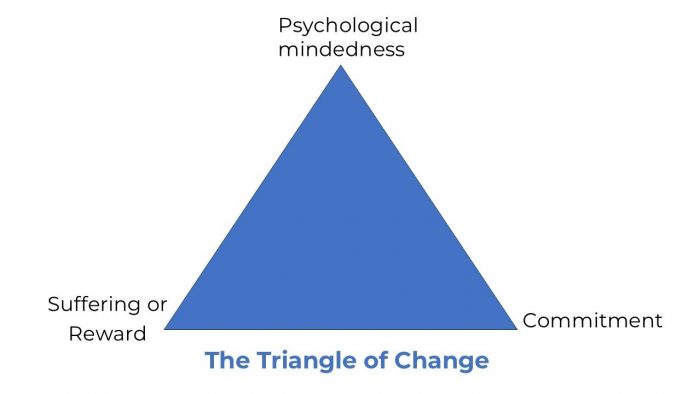
Firstly then,
if we’re not suffering enough, or the reward isn’t big enough
then it’s unlikely that we’ll change our ways.
With our example of ‘I should be getting more exercise’, if our lack of fitness – the suffering – isn’t impacting us too much, to the extent that it’s causing us physical, or mental problems (getting us down for example), we won’t have sufficient drive to do something about it.
What we can do though is to think through the reward we’ll be getting:
💡how good I’ll feel and look, and perhaps
💡what I’ll be able to do that I can’t do now because I’m not fit enough
We can ask ourselves:
🤔 “How will I feel if I do make a change?” (e.g. proud of myself) or
🤔 “How will I feel if I don’t make a change?” (e.g. disappointed in myself)
Psychologically-minded
people are those who have a degree of awareness of how the mind works, and the effect emotions and beliefs can have on ourselves and others.
They’ll understand the connection between beliefs and behaviours.
If we’re psychologically minded we’ll also be open to persuasion, recognise and accept that there may be other alternative views to our own, and be able to self-reflective and challenge our own behaviours and beliefs on occasion.
It’s possible as a result for us to change our perspective, our point of view, our minds, and review how we see and interpret events.
We’re more likely to be flexible then, and not dogmatic. We’ll recognise and take responsibility for what we do and what happens to us as a result.
Having a good level of self-awareness, we’ll be able to ask ourselves: “What’s my impact here?” and “Why am I feeling this way?”
Making a change can come more easily in these circumstances.
Finally,
committing to taking action
is required, and having a simple plan to maximise the chances of success, and being determined to carry it out.
With our example of wanting to exercise more: we can ask ourselves: “What do I need to have in place/what prep work can I do e.g. having the necessary kit; the right environment; the time and opportunity; who to tell (perhaps no-one) about my new exercise regime?”
AND we might want also to anticipate any potential barriers to achieving, what might get in our way, what we’ll do in these circumstances, so we can deal with them should they occur.
We’re working here then with commitment, as distinct from motivation, deciding on a plan of action, and getting on with it. Having said that, how about giving yourself a reward of some kind, in addition to the feel-good factor you’ll experience, if that might provide extra motivation?
We should acknowledge here too the benefits that can accrue to our self-image, how we feel about ourselves, our self-belief and confidence about what we’re capable of and can achieve.
Committing to change, even small changes, is the very thing that can help us to enhance our self-image, our level of self-efficacy, in a virtuous cycle.
🤔 Is there a small or larger change to a habit, behaviour or way of thinking, that you’d like to commit to, for a better version of you?
Do get in touch if you’d like a word about how you can go about applying the Triangle of Change to your own life.